


3 min read
Everyone loves a good Aussie BBQ. Every school year ends with one. And someone always says, “Gee it must be nice. Six weeks off!” Yes, coasting on a river of holidays sure sounds good, but it couldn’t be further from the truth. Here’s the reality of teaching life.
What Teachers Actually Earn
Let’s start with the money. Starting out, an Australian teacher earns between $75,000–$80,000 per year. In order to get there, they need a four-year university degree. As experience grows, so do postgrad credentials and hundreds of hours of mandatory professional development. Regulatory requirements add pressure to in-class and out-of-class conduct with risk of suspension.
Compare that to other professions with a four-year degree like engineers, accountants, or IT pros. They out-earn teachers without the same level of after-hours workload that comes from day one.
While balancing the books and building roads are incredibly important roles, teaching involves duty of care for up to 30 small humans. Managing educational, emotional, and social development is a big mission. Not to mention handling various learning for students with disabilities, gifted needs, behavioural challenges, and non-native English speakers all in the same classroom.
The Hours Nobody Sees
Looking at teaching time alone, it’s easy to see a lighter workload. Teachers arrive around 8:30am and finish around 3:30pm. That doesn’t sound obscene, but there’s a lot behind the curtain. Secondary school teachers only spend up to 25 hours a week actually teaching.
The other 25 hours are dedicated to:
• Lesson planning and curriculum design
• Assessment design and marking
• Report writing and parent communication
• Staff meetings and mandatory training
• Yard duty and subject coordination
• Compliance documentation
The research is clear. Research cites full-time teachers are working 50–55 hours weekly during the school term. Reports are not written during school hours. Essays are not marked during school hours. Parent emails arrive at 10pm and are answered before the next morning’s class. Lesson plans for Monday mornings are built on Sunday afternoons. This does not even take into account after school meetings, school events on evenings, weekend sport or school camps: many of these activities are on top of the standard hours a teacher works.
About Those Holidays
Everyone loves a good holiday. Yes, 12 weeks of leave looks much bigger than the standard four weeks for others, but here’s how the math breaks down. Teachers teach for roughly 40 school weeks per year, while their annual salary is distributed across 52 weeks. When you calculate their 50ish hours every week across 40 weeks of school terms, it adds up to more hours than standard workers who clock 38 hours per week across 48 weeks. This break is actually compensation for the unpaid overtime baked into school terms.
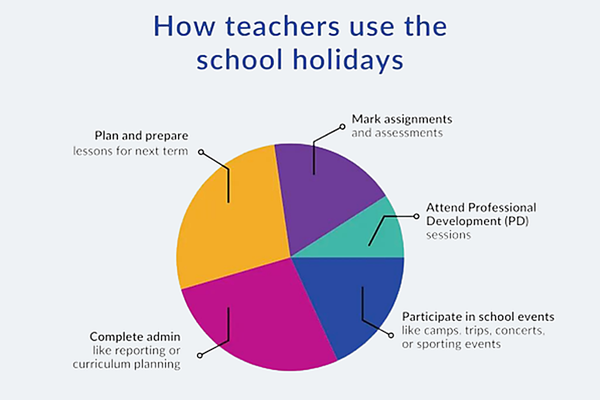
And it’s not a full dedicated break. School holidays aren’t actually time away from teaching, but dedicated to playing catch up on more invisible labour. This is when curriculum planning happens, assessment preparation, professional development, marking backlogs, resource creation, and coordinating scheduling with co-workers.
The Hidden Costs
Teaching has a lot of hidden costs. While studies suggest teachers spend $500–$1000 of their own money on classroom items each year, there’s a far bigger cost. Mental health is at risk. Teaching consistently ranks in the highest-stress professions with severe burnout rates. The difficulty of catering to 30 diverse learners, managing the emotional labour, and absorbing community frustration takes a toll that doesn’t appear on any pay stub. It’s no wonder nearly half of new teachers leave the profession within five years.
Why This Myth Persists & Why It Matters
The invisible workload is necessary to do a good job, but it’s overlooked. People see the holidays. They don’t see the Sunday marking pile. They see the early finish. They don’t see the 10pm email to the parents of a struggling child. To make matters worse, ignoring the unseen work isn’t as harmless as you think it is.
These myths shape public attitudes toward teacher conditions and pay conversations. They undermine community respect. And they’re creating an impossible recruitment and retention crisis that spans from Darwin to Geelong. We don’t need less teachers. We need more great ones.
Shaping the minds of tomorrow and connecting with students is a huge job that deserves fair credit. So the next time someone reaches for that line about school holidays, it’s worth asking if the job is so cushy, why is there a national teacher shortage?
Not a member?
Give us a call. We’re Australia’s most contactable professional association, and we work harder for our members when it matters most.
We’d love to hear from you and learn how the TPAA can support you.

Related Posts
The Wisdom Advantage: Giving New Teachers a Hand
Every experienced teacher remembers their first year. The classroom management strategies made...
Case Win: Allegations Against Teachers
Advocacy & Support for Teachers
Teachers are entrusted with shaping young minds and fostering an...
Case Win: Supporting Teachers Against Workplace Bullying
Empowering Educators to Confront Workplace Bullying with Confidence
In the realm of education,...